Denver · Heat and calibration
Keeping a Gas Oven Igniter and Bake Burner Healthy
On the professional gas ranges the thermostat does two things in one movement: it warms a glow-bar igniter, and it calls on the electromechanical valve feeding the burner. So when a gas oven is reported as slow, what we usually find is not a burner that will not light but an igniter drawing less than it once did: the gas waits, the smell arrives first, and the heat follows a minute or two behind.
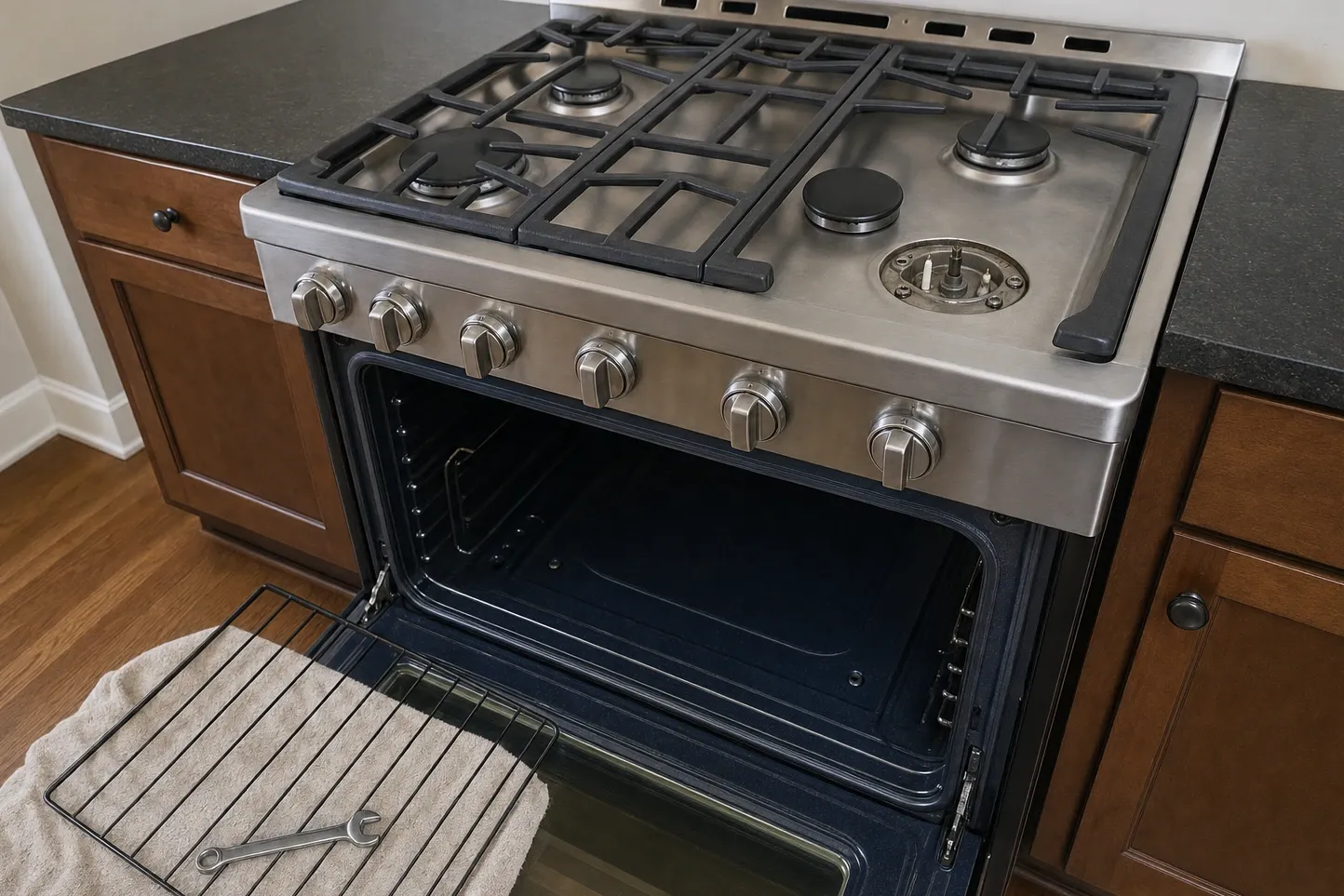
What the delay is actually reporting
A glow-bar sits in the gas path as a resistance rather than as a switch, and the current through it does two jobs at once. It heats the bar until the bar is hot enough to light gas, and it satisfies the valve that opening is now worth doing. As the bar ages it draws less, so the valve waits a little longer each season while the bar itself still glows and still looks healthy. That is why a slow gas oven is measured rather than looked at: an igniter can be bright orange and be finished.
The same circuit accounts for two other complaints. A gas oven that does nothing while the cooktop can still be lit by hand is an electrical question before it is a gas one — Viking is plain that in an outage the igniters will not work and the oven is not to be operated. And a burner catching late in every cycle reads on a thermometer exactly like a cavity that bakes cold.
Where owner care stops
Wipe spills from a cold cavity, keep foil off the oven floor, and stop there. The burner, the igniter and the valve sit behind panels and in a gas line, which makes them a visit rather than an afternoon.
| What you notice | What it usually is | Yours to touch? |
|---|---|---|
| A smell of gas for a moment before the heat | An igniter warming more slowly than it once did, so the valve opens late. Less often a burner port partly blocked by a spill. | No. The delay is measured, not adjusted. |
| Lights eventually, then bakes under the dial | Late ignition in every cycle, which a thermometer records as a cavity that never reaches the number. | Measure it and note it. The repair is ours. |
| Cooktop lights by hand, oven does nothing | A supply question before a gas one. Viking says outright that the igniters do nothing in an outage. | Check the breaker and the plug, then stop. |
| Baked-on spills on the oven floor | Soil near the burner that will smoke, and can sit over a port. | Yes, once the cavity is cold, with hot water and detergent. |
Follow-ups
Is a smell of gas before the heat normal?
A brief trace as the burner catches is ordinary on a gas oven. A smell that lingers, or one you notice with everything switched off, is not: leave the house, ring the gas utility from outside, then ring Viking Pro Repair Denver on (720) 790-9436.
Can I clean the igniter myself?
No. It is a brittle bar sitting in the gas path, and a cloth is enough to snap one. Keeping the cavity floor free of spills is the useful half of the job; the rest belongs to Viking Pro Repair Denver on (720) 790-9436.
The power was out for an hour. Can I use the oven now?
Once it is back, yes. During the cut, no: the igniters have nothing to work with, and Viking's instruction for a gas range is to leave the oven alone entirely. If it sulks afterwards, Viking Pro Repair Denver is on (720) 790-9436.