Denver, Colorado · independent Viking service
Viking Oven Repair
in Denver
Wall ovens and range ovens — calibration, igniters, elements, self-clean and door faults. Tell us the series and what the oven did, and we will tell you the pattern it fits.
- Diagnosis
- $89 flat, deducted when you approve the work
- Van hours
- 8 am until 8 pm, seven days a week
- Someone picks up
- 24/7

Start here
Find your oven, then we can talk about what it did
Half of what happens on a Denver oven call is decided before anyone leaves: which cavity, which control, which igniter. Pick the one that looks like yours and the chapter will tell you where the plate hides on it.
- Electric wall oven One cavity or two, built into a cabinet column, elements top and bottom.
- Gas wall oven Built in like the electric one, but with a gas burner and an igniter under the floor.
- Range oven, gas The cavity under a professional gas cooktop, lit by the same kind of igniter.
- Range oven, dual fuel Gas burners on top, an electric oven underneath — the commonest remodel choice here.
- French door oven A built-in oven whose door splits down the middle and opens outwards in two halves.
- Not sure which Start at the plate. The page below says where it is on each of these.
Reading the plate over the phone with Viking Pro Repair Denver on (720) 790-9436 usually decides which parts travel to the address that day.
Out of hours
Gas you can smell, or a door locked shut with dinner inside it
Smell gas at an oven: turn every knob off, leave the room, and ring from outside — the gas utility or 911 first, then us. A clean cycle that has latched the door is the other one worth a call tonight rather than in the morning, because the cavity needs to fall a long way before the latch will let go. This line is picked up 24/7, even though visits run 8 am until 8 pm, seven days a week.
What we usually find
Five sentences, and what each one nearly always turns out to be
Patterns, not case files. Tell us the series and what the oven did, and the answer usually starts in this list.
-
It says 350 and it bakes nearer 320.
UsuallyA sensor that has drifted a little each year, or a door that has stopped sealing square, so the cavity averages under the number on the dial. Denver bakes slow at this elevation before the appliance contributes anything, which is why the recipe notices first.
NotA failed bake element. An element that has actually failed does not run cold — it does not heat at all.
-
The clean cycle finished and the door never let go.
UsuallyUsually the clock. Viking puts the cycle at about three and a half hours with a further half hour of cooling before the latch will disengage, and most calls arrive inside that half hour. Where the latch genuinely is stuck, it is the lock motor, its cam or the switch that reports where it sits.
NotA broken door. The door is fine; the thing that holds it is what needs looking at.
-
The gas oven takes forever to come up, and there is a smell first.
UsuallyA tired glow-bar igniter. On the Viking gas ovens that use one, the igniter sits in series with the oven valve — it can still glow convincingly and no longer pull enough current to open it promptly, which is exactly the delay people describe.
NotThe thermostat. A control that never got gas cannot be blamed for the temperature it never reached.
-
There is a whirring from the back whenever the oven is on.
UsuallyA fan doing its job, most often. Viking mounts a motorised convection fan at the rear, runs a separate cooling fan through the whole clean cycle, and prints in its own guides that the high-speed convection modes are audible. A bearing that has started to complain sounds different and gets louder with heat.
NotA blocked filter. There is no filter behind that cover on any Viking oven we work on.
-
The cooktop lights, the oven is dead, the panel shows nothing.
UsuallyThe supply to the oven side, more often than the control. A gas range keeps its surface burners on a match in a power cut, and Viking says plainly that the oven should not be operated at all then — so a dead panel with live burners points at the circuit before it points at a board.
NotA failed control board, as a first guess. Boards do fail; they are rarely the cheapest thing to have eliminated first.
Pattern notes — Viking Pro Repair Denver, (720) 790-9436.
On the display
What the panel is trying to tell you
The same two characters do not mean the same thing on every Viking control generation, which is why each of these has a page rather than a row in somebody's chart.
- F1One family reads it at the probe, the later control reads it at the latch.
- F3Two different faults share these characters, and the control decides which.
- F01 / F07The panel is unhappy about the latch, and the cavity is still cooling.
- A flashing clockA prompt rather than a fault code, and the reason nothing will start.
- NothingA silent panel over live burners narrows the problem before anyone arrives.
The whole display table or read it out to Viking Pro Repair Denver on (720) 790-9436.
The handbook
Nine chapters on keeping a Viking oven honest
Written for the owner, not for a technician: where the plate is, how to measure the cavity, what the clean cycle does to a latch, and which parts of a door are worth touching.
Knowing the oven
Heat and calibration
- 02Checking a Viking Oven Against a ThermometerHow to take a cavity reading that means something, and what the average tells you.
- 03Keeping a Gas Oven Igniter and Bake Burner HealthyWhat the delay before the heat is reporting, and where owner care stops.
- 04The Convection Fan: What to Listen ForWhich of the sounds in a Viking oven you are hearing, and when one matters.
- 05The Infrared Broiler: Use and CareA gas burner glowing through a metal screen, and the one rule about running it.
The clean cycle
The door
The whole handbook — or describe it to Viking Pro Repair Denver on (720) 790-9436 and skip the reading.
In Denver kitchens
What the visit was actually like
4.9/ 51,802 reviews
Convection began rattling like a stone in a can partway through a roast. A gone bearing in the fan motor, ordered against the serial plate and fitted two days later. No fuss, no upsell.
Xavier M.Hilltop
The range came with our bungalow and simmered like a blowtorch. He fitted orifices sized for our altitude and reset the manifold pressure. Low now actually means low, which matters for sauces.
Percy D.Sloan's Lake
Ice kept sheeting over the freezer floor, which made no sense in a Denver winter this dry. The drain was frozen at its base and a hinge had let the door sit proud. Both handled in one call.
Gwyneth S.Hilltop
The route
The sector: west bank of the lake to the eastern wedge
Seven districts, and the oven work in each one has its own character — paired wall ovens on the big eastern lots, range ovens in the bungalows out west. Anywhere else in Denver, ask on the phone and you will get a straight answer about the day.
- Edgewater Its own municipality beside the west end of the lake, with kitchens where the oven is part of a range and not a cabinet appliance.
- Wheat Ridge A separate city out past the lake, where an oven may well answer with a knob and an indicator light instead of a display.
- Sloan's Lake 80212 Lakeside bungalows and scrape-off duplexes, most with a new kitchen built around a professional range.
- Baker 80223 Brick Victorians and half-duplexes off Broadway, where the kitchen is usually one narrow galley.
- Bonnie Brae 80209 Curved streets of 1920s bungalows and Tudors, compact kitchens fitted with full-size appliances.
- Hilltop 80220 Wide lots and 1950s ranch houses, remodelled kitchens with paired wall ovens and built-in refrigeration.
- Crestmoor Wide post-war lots east of Hilltop, and kitchens rebuilt around a tall cabinet with two ovens stacked in it.
Asked on the phone
The six questions that come up first
If yours is not here, ask it on the call — (720) 790-9436.
What does a visit cost, and does the $89 come off the repair?
It does. The $89 buys the trip and the full diagnosis, and it is deducted the moment you approve the work. You are told the repair price out loud before anything is taken further, and stopping there costs you the $89 and nothing else.
My oven bakes cold. Is that the oven or is it the altitude?
Measure it and you will know. Put a thermometer on the centre rack, let the cavity soak well past the preheat signal, then read it several times. An average close to the dial means the recipe needs the altitude adjustment. An average well under it does not.
The clean cycle finished hours ago and the door is still locked.
Give it the cooling time first. Viking puts the cycle at about three and a half hours and then another half hour before the latch will release, and most of these calls land inside that window. Still locked well after that and it is the lock assembly.
Do you work on the cooktop as well as the oven underneath it?
The oven is what this shop is set up for — calibration, elements, igniters, self-clean, doors and controls. Burner and rangetop work is on the range page, and it gets done on the same visit when the range has both faults at once.
When can somebody actually come out?
Somebody picks up at any hour, and the van runs 8 am to 8 pm daily. What that means for your kitchen is settled on the call: you are told which slot is genuinely free before you rearrange a day around it, not after an afternoon spent waiting in.
What is worth having in front of you when you ring?
The model and serial number, what the oven did, and whether the cooktop still works. On a Viking those numbers sit on a plate at the oven opening or behind the lower panel, depending on the family — and they usually decide which parts travel that day.
Why this equipment, in this city
Professional ranges live a harder life at 5,280 feet
Viking built its name on commercial-style equipment moved indoors: sealed burners with real output, cast grates heavy enough to hurt, a griddle plate where an ordinary range puts a fifth ring. Equipment like that is worth repairing rather than replacing, and it rewards being set up properly.
Gas does not care what the badge on the door says.
Denver is where that setting-up matters. Thinner air means a burner jetted for sea level burns rich, sooty and lazy on a low flame, and an oven calibrated in a coastal factory reads warm here. Add winter air dry enough to harden a door gasket and cottonwood fluff that packs a condenser coil solid by July, and the same four faults come round again and again.
So the work is mostly measurement: manifold pressure, orifice size, a probe in the cavity next to whatever the dial claims, current draw on a pump before anyone condemns it. Parts get changed when a reading says so.
- Manifold pressure and orifice sizing checked against the altitude, not the label
- Cavity temperature read with a probe before the calibration is touched
- Condenser coils cleared as part of a refrigeration call, not sold as an extra
- Custom cabinet fronts removed and refitted to the alignment they had

Reported, then found
The same three sentences, most weeks
Not case files — patterns. These are the descriptions that come down the phone most often in Denver, and what they usually turn out to be once the panels are off.
-

Reported
The oven door will not pull shut, and the glass has fogged over.
Usually found
Sagging hinges on one side and a door gasket squashed flat. The door itself is rarely bent — it is the hardware carrying it that has given up. Both sides get renewed together so the cavity closes square again.
Oven Repair -

Reported
Water still standing in the bottom when the cycle ends.
Usually found
A drain pump that spins without moving anything, or a sump silted up behind the filter. The hose loop and the air gap are checked in the same visit, because a slow drain and a dead pump feel identical from the front.
Dishwasher Repair -

Reported
The front burner ticks for a minute before it catches.
Usually found
A cracked igniter cap, or an electrode still damp from a boil-over. Drying and cleaning the electrode is often the entire repair. Replacing a spark module because the ticking sounds expensive is how a small fault turns into a large invoice.
Range Repair
What gets worked on
Four repairs, and the symptoms that lead to them
-
 Range Repair Ignition, simmer control and altitude-related burner faults on Viking professional ranges.
- A burner that ticks away for a minute before anything lights
- Lazy orange flame where there ought to be a tight blue cone
- The low setting will not hold and the flame goes out on its own
- One end of the griddle plate scorches while the other stays cool
-
 Refrigerator Repair Built-in and panel-ready Viking refrigeration: cooling loss, frost build-up and door-seal work.
- Fresh food section sitting in the high forties while the freezer stays cold
- Frost sheeting across the freezer floor or up the back wall
- Condenser fan howling, or a compressor that never cycles off
- Custom panel door hanging low and no longer sealing
-
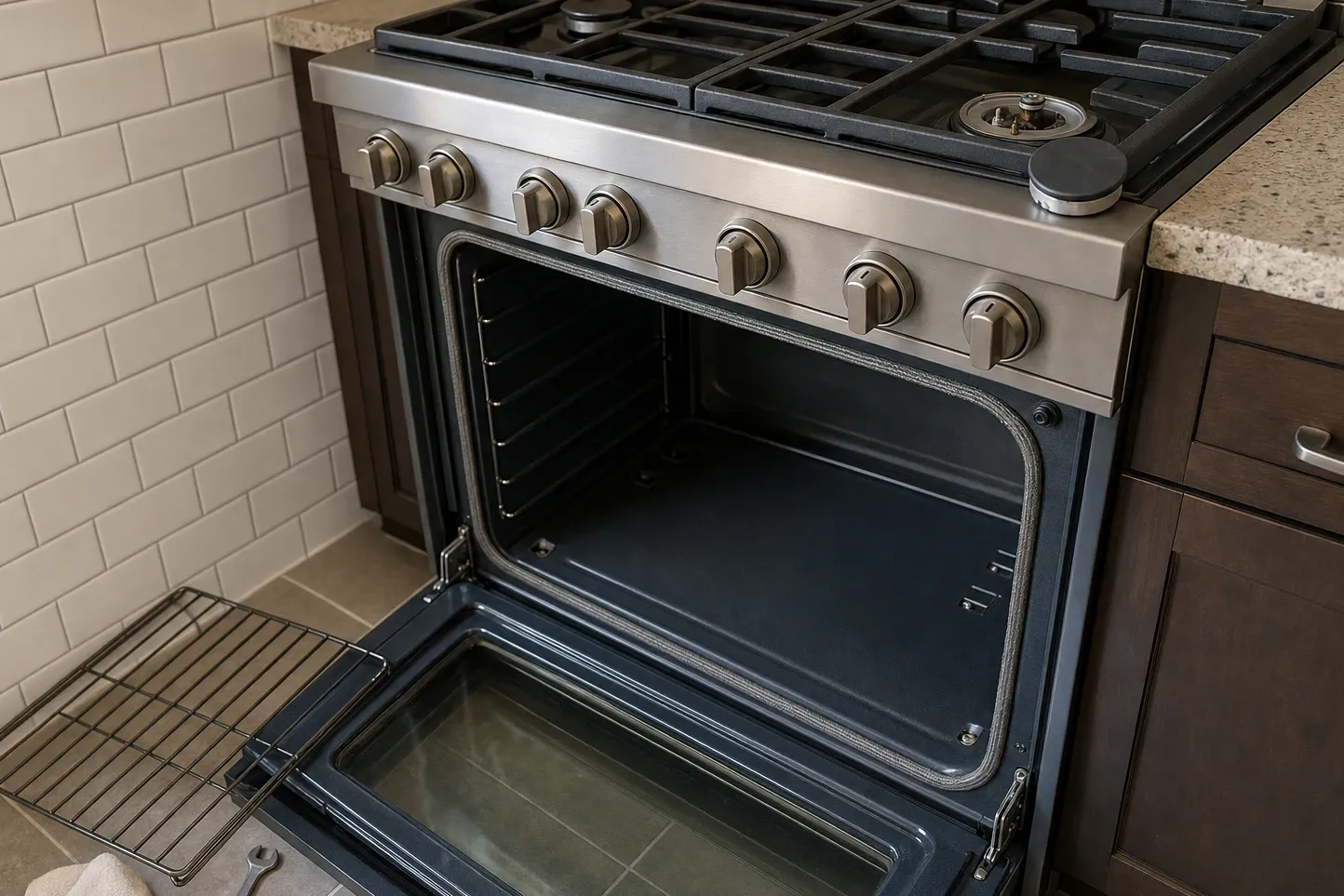 Oven Repair Calibration, element, hinge and control work on Viking wall ovens and range ovens.
- Oven bakes well below the temperature on the dial
- Nothing browns, and everything takes longer than the recipe says
- Oven goes dead after running a self-clean cycle
- Door will not pull shut, or the glass has fogged over
-
 Dishwasher Repair Fill, drain, spray and leak diagnostics for Viking integrated and panel-front dishwashers.
- Water left standing in the bottom when the cycle ends
- Machine hums but never takes on any water
- Water seeping out at the door and onto the floor
- Cycle halts partway through and the panel lights blink
Book it
Tell us the series and what the oven did. We will tell you the pattern it fits.
The van runs 8 am until 8 pm, seven days a week; the phone is picked up 24/7. Your $89 pays for the journey and the diagnosis, then comes straight back off the bill when you approve the repair.