Oven Repair
Viking oven bakes cold: what recalibration fixes, and what it hides
Clifford NakamuraService technician — controls and intermittent faults · 22 years in the trade
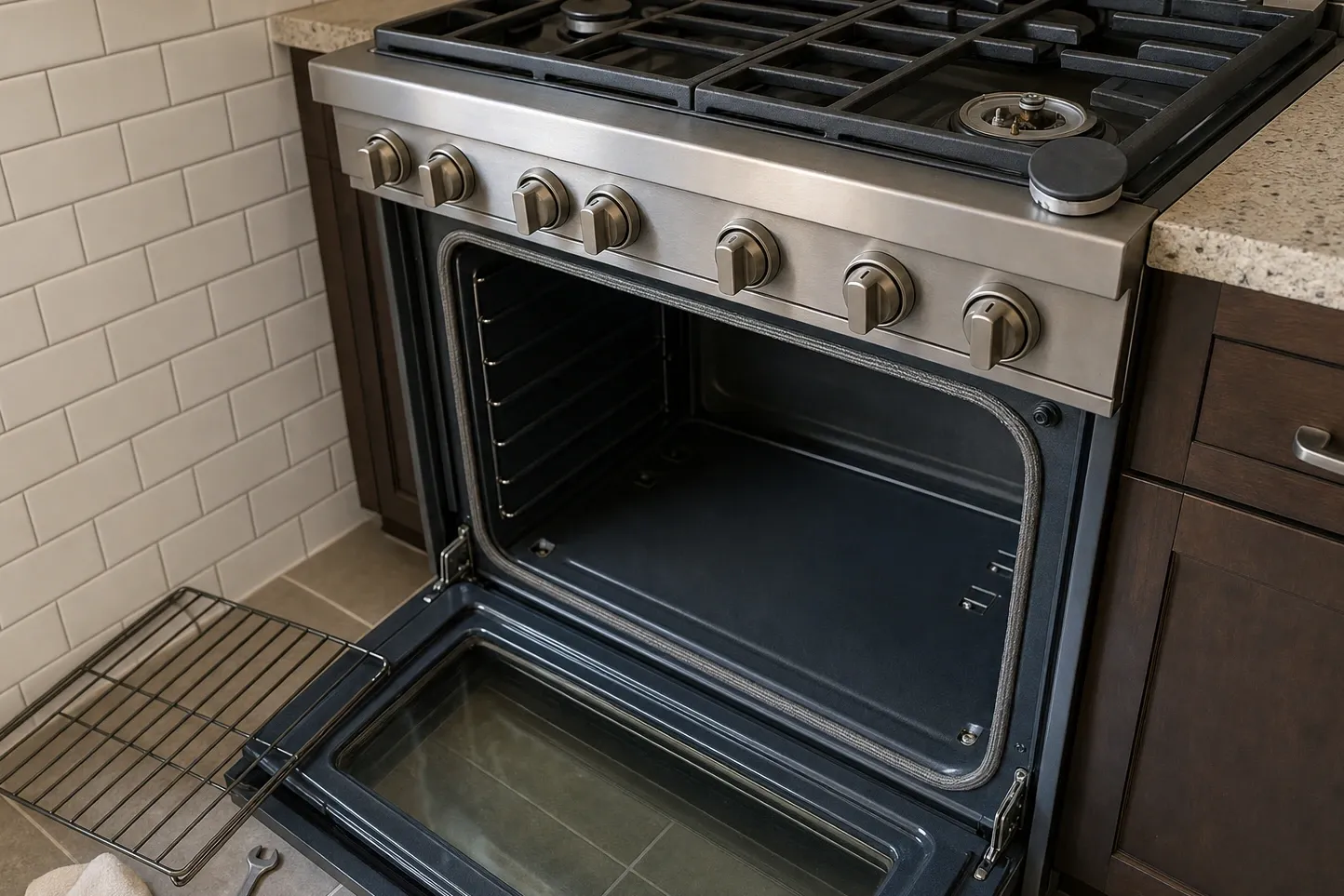
“It says 350 and it bakes like 320.” That sentence turns up on the phone most weeks, and it is worth taking seriously — a wall oven that runs cold ruins pastry, bread and anything with a leavening agent in it long before it ruins a roast. But it is also the sentence that most often leads to the wrong repair, because the control can be told to lie in the opposite direction and make the complaint disappear without fixing anything.
Here is how to find out what your cavity is actually doing, and what the offset setting is honestly good for.
First, measure it properly
Most measurements that arrive with the complaint were taken in a way that produces a wrong answer every time.
Put an oven thermometer on the centre rack, in the middle, not touching a wall. Set the oven to a temperature you actually bake at. Then wait — not for the preheat beep, but for a further twenty to thirty minutes. The beep marks the first time the sensor saw the set point, which is the least representative moment of the whole cycle.
After that soak, read the thermometer every five minutes for a quarter of an hour, through the door glass rather than by opening it. Write the numbers down. You are looking for the average of the swing, not the peak: an oven that cycles between 335 and 365 while set to 350 is behaving exactly as designed.
If the average sits within about fifteen degrees of the set point, the oven is fine and the problem is somewhere else — usually the recipe, at this elevation. If the average is twenty-five or more degrees under, something is wrong and the next question is what.
What the offset setting is for
Viking controls, like most, allow a limited calibration offset — a fixed shift of the whole curve, adjustable a couple of dozen degrees in either direction. It exists for one specific situation: a cavity whose readings are consistent, stable and simply parked a little low or a little high.
It shifts everything by a constant. That is all it does.
So an offset cannot correct a swing that is too wide. It cannot fix a preheat that has doubled in length. It cannot even out a cavity that browns well at the back and pale at the front. If any of those are the real complaint, an offset just moves the whole problem up the dial and hands you a hotter version of the same fault.
The three faults recalibration only hides
A door that no longer seals. The braided gasket around the cavity flattens with age, and hinges sag on one side long before anyone notices. Heat leaks out of the top of the door, the element runs longer to compensate, and the cavity still cannot hold its average. Tell-tales: fogged glass, a door that needs a shove, uneven browning front to back. Renew the hinges in pairs and the gasket with them.
A drifting temperature sensor. The probe in the cavity wall is a resistance device: its resistance rises with heat and the control reads temperature from that number. On the common thousand-ohm type it should read somewhere around 1,080 ohms at room temperature. A sensor that has drifted high tells the control the oven is hotter than it is, and the control obediently stops heating early. That is a five-minute meter check and a cheap part, and no amount of offset fixes it, because the drift is not constant across the range.
An element or igniter that is only half working. On a gas oven, a weak igniter draws too little current for the safety valve to open promptly, so the burner lights late in every cycle. On an electric cavity, an element open on one leg heats at a fraction of its rating. Both look exactly like “runs cold” from the outside, and both are measured rather than guessed at.
Baking at 5,280 feet: what altitude does and does not change
Altitude does not make a cavity run cold. It changes what happens inside the food in it, and the two get confused constantly.
At this elevation, lower air pressure means water boils nearer 202 degrees than 212, leavening gas expands more eagerly, and dry air pulls moisture out of a batter faster. Cakes rise fast and then collapse. Bread over-proves. Biscuits spread and dry at the edges. None of that is the appliance, and no calibration change will fix it — the standard answers are a little less leavening, a little more liquid, and a slightly higher temperature for a slightly shorter time.
What altitude does affect on the appliance side is the gas burner in a gas oven, for the same reason it affects a rangetop: a mixture jetted for sea level burns rich here. That shows up as sooting and slow ignition rather than as a cold cavity, but if both complaints arrive together they are probably the same underlying cause.
When to stop measuring and call
Have someone out when, after a proper soak and several readings, any of these is true: the average is more than about twenty-five degrees off the set point, the swing is wider than fifty degrees, the preheat takes markedly longer than it used to, the glass fogs, or the oven has gone dead at the end of a self-clean cycle — that last one is usually a thermal cut-out doing precisely the job it is there for.
Bring the model and serial number to the call. The sensor resistance table, the element rating and the offset range are all model-specific, and knowing which control board is in front of us decides whether the fix travels on the van. Your $89 pays for the journey and the measuring, and it is deducted the moment you agree to the repair.
Follow-ups
How much swing around the set temperature is normal?
A cycling oven is meant to swing. Fifteen to twenty-five degrees either side of the set point through a bake is ordinary behaviour and is not a fault. Judge the mean of several cycles; the single highest and single lowest readings tell you nothing useful.
Should I adjust the offset myself?
You can, and it is reversible, but do the measuring first. An offset entered against a single reading taken during preheat usually makes the oven worse, because preheat is the least representative part of the cycle.
Is my cake sinking because of the oven or because of the altitude?
Test it against the thermometer. If the cavity holds its average within about fifteen degrees of the set point, the oven is doing its job and the recipe is what needs adjusting for elevation. If the average is well under, the appliance is the problem.